The fact is that "standard" CCTV cameras are not designed to capture number plates. Most are designed for general monitoring and observation of a wide area, not for capturing clear detail from moving vehicles. One of the biggest mistakes people make when designing a system is expecting one kind of camera to do everything.
Results can vary when trying to capture details from vehicles. It is only partly to do with the manufacturer, resolution, megapixel count or cost of the camera. In many cases, it is more to do with the setup of the system and what the camera is being expected to do.
Of course, a poor-quality camera will not perform as well as a higher-grade model, but camera quality alone is not always the main factor when it comes to motion blur. Many high-end models can still suffer from motion blur if they are not set up correctly.
How this works can be explained using the "exposure triangle". The exposure triangle describes the relationship between aperture, shutter speed and ISO. These affect depth of field, motion blur and image noise.
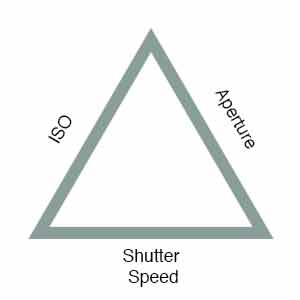
Aperture = This is the size of the lens opening, which determines the amount of light that can enter the camera. It also affects depth of field. Depth of field can be explained as how much of the image is in focus.
A narrow depth of field is where the subject is in focus while everything behind the subject is out of focus. A large depth of field is where more of the general image is in focus. For most CCTV applications, you would want a large depth of field.
Shutter Speed = This can cause motion blur. A video camera takes a series of fast "photographs" which expose the image to the sensor of the camera. Shutter speed can vary from a few times per second to thousands of times per second. Do not confuse this with frames per second, which is known as FPS.
ISO = This can cause image noise and relates to how sensitive the image sensor on your camera is. Increasing the sensor sensitivity, or ISO, can make the picture appear brighter, but it can also make the image more grainy.
Now we have covered some of the jargon and terminology, we can explain how this relates to being able to identify the car that threw rubbish into your garden at one in the morning.
To achieve bright, sharp and clear images with CCTV, we need to let enough light into the camera sensor. If there is not enough light, the image can become dark and grainy. It can also affect the camera's ability to focus correctly.
We know that a faster shutter speed reduces motion blur and longer shutter times create more blur. It is then easy to think that increasing the shutter speed is the answer. Unfortunately, it is not quite that simple. Each part of the exposure triangle affects the others, so you cannot usually adjust one setting without affecting something else.
When we use a faster shutter speed, we reduce the amount of light available to the image sensor. So why not increase the shutter speed and then increase the ISO to make the picture brighter?
The problem is that image noise increases. You could, in theory, increase the aperture, but most CCTV cameras do not have aperture adjustment. They normally have a fixed aperture, as adjustable aperture cameras are more expensive.
In this situation, you can adjust the shutter speed and try to find a balance. The aim is to get enough light onto the sensor for an acceptable image of the general area, while still using a fast enough shutter speed to reduce motion blur.
This, of course, can be a compromise, so having the correct cameras from the start can make a big difference.
Understanding the purpose of the CCTV system is essential when selecting the correct camera.
There are CCTV cameras available with bigger apertures, and these can reduce some of the issues found with cheaper cameras. A good example of a camera more suited to capturing a moving vehicle is the Hikvision Darkfighter range of CCTV hardware.
Still, there can be an issue with capturing plates reliably when the vehicle is moving. Physics does not allow us to escape the exposure triangle, so planning is essential.
If capturing number plates is a must, this is where a dedicated camera designed for number plate capture is needed. These cameras use the exposure triangle to their advantage. The exposure, or "shutter speed", is incredibly fast and produces a very dark picture except for the number plate. Light is reflected back to the camera from the number plate's reflective surface, allowing the camera to capture the plate. Motion blur is reduced because of the fast shutter speed.
These specialist cameras are known as ANPR cameras. They can be used with a suitable NVR, VMS or software platform to read the text or digits on the plate and log the result.
Very often, we use an ANPR camera alongside a regular CCTV camera. This regular camera is known as an "overview" camera and allows you to capture colour images and other important details that the ANPR camera may not show.
Not only can the system log number plates, it can also perform actions based on number plate reads, such as sending an alarm or opening a gate. More information on these cameras can be found on our ANPR & vehicular detection page.
Light is critical for any CCTV system, or any other type of camera for that matter. A well-lit area will provide far better images than a poorly lit area. Improving the available light should be one of the first steps when trying to reduce motion blur.
Cameras that are exposed to environmental pollution can also get dirty very quickly, so ongoing maintenance, such as cleaning, will also help.
Other factors that affect the camera's performance with moving objects can include:
To capture reliable images that can identify number plates, the right cameras need to be selected and they need to be set up correctly.
There are dedicated systems designed purely for capturing car registration plates. What you should be aiming for depends on the needs of the property or area where the cameras are being installed.
Sometimes, but not reliably. Standard CCTV cameras are usually designed for general observation, not for consistently capturing moving number plates. Speed, angle, lighting, shutter speed and camera setup all affect the result.
At night, CCTV cameras have less light available. This often means the camera uses slower shutter speeds, higher gain or infrared lighting, which can cause blur, glare or overexposed number plates.
For reliable number plate capture, a dedicated ANPR camera is usually required. These cameras are designed to use fast shutter speeds and suitable lighting to capture plate detail from moving vehicles.
A camera may capture the vehicle body clearly while still missing the number plate. Number plates are small, reflective and often moving quickly through the scene, so they require a more controlled camera setup.
Yes. An ANPR camera is mainly used to capture the number plate. An overview camera helps provide the wider scene, vehicle colour, direction of travel and other visual details.